Books to Read to Better Understand Our Goverment and Politics
This content contains chapter links. When yous buy through these links, we may earn an affiliate commission.
A list of 25 books will never be able to cover all the great political books on a global scale, but it tin can provide you a starting place! This list is a compilation of some of the classic founding political theory books, an try to include political writing beyond what might be considered traditional "political theory canon," an exploration of intersectionality and politics, and a reflection on some of the major topics that play a role in our political discourse today.
While creating a comprehensive list of the best political books would be an incredibly big undertaking, and perhaps impossible, I call back this list volition be a great starting place for people who want to larn more than near political history, and meliorate understand some major political theories and concepts.
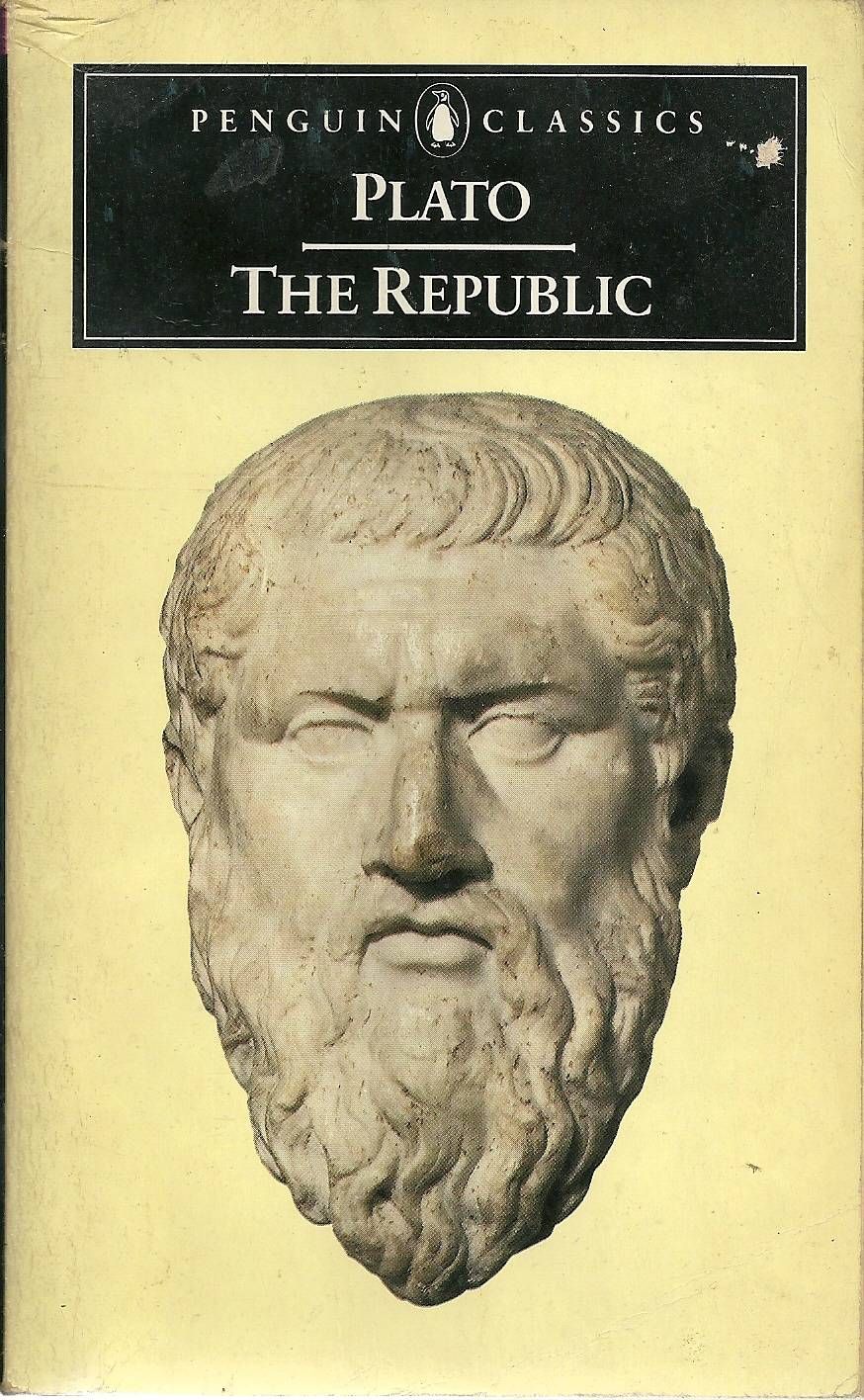
The Commonwealth by Plato
The Republic is a Socratic dialogue authored past Plato onetime around 375 BCE. Plato argues that knowledge should be the determining factor as to who should rule the people, because those with the most expertise—in Plato's view philosophers, like himself—will be the virtually fair and efficient leaders. This text was written prior to the time when "commonwealth" was outset put into words a political concept, and manifestly Plato's concept of a republic led by philosophers is not really used in many of today's modernistic states today. Even so, information technology was a foundational political text in the west at the time. And interestingly, we saw similar thinking in other parts of the world, like in the writings of Confucius who wrote about "benevolent hierarchy" in Red china around the same menstruum. Much afterward, philosophers would telephone call this thinking "benevolent dictatorship" or "benevolent tyranny," only nosotros'll get to that idea afterwards.
The Social Contract by Jean-Jacque Rosseau
Jean-Jacque Rosseau was a French philosopher who published this essay about the social contract between governments and people in 1762. The basic principle of his "social contract" is that laws are binding simply when they are supported by the will of the people. This concept positions the will of the people above the authority of government, which was in a stark contradiction to governance in France at that fourth dimension. In Rosseau's time, the French monarch was thought to be divinely bestowed, and, of course, they could hand downwardly laws without regard for the volition of the people. Rather, they often backed laws that served an elite few. Because of this, Rosseau's radical treatise became a founding text for The French Revolution and the political reformation to come.
A Vindication of the Rights of Women by Mary Wollstonecraft
Published in 1792, this is ane of the offset feminist political texts. Wollstonecraft simply argues that women are deserving of the same fundamental rights every bit men. She specifically argues that women have a correct to exist educated, and makes the instance by reasoning that every bit the the moral compasses for social club, and the people responsible for raising future generations, it was logical for women to be properly educated. The context of her writing nigh liberty and rights is significant, considering this text was published during the French Revolution. Because of the sentiment of "liberté, égalité, fraternité" that was in the air during the time of the revolution, this message of women's equality was actually generally well-received in its time. Unfortunately, it wasn't acted on politically, but the text became a foundational work for later suffragette and feminist movements to come up.
The U.s. Constitution
The guiding principle of the United States Constitution is that people have "unalienable rights," which is a divergence from the previously prevailing idea that human rights are "given" to the people by the land. In contrast, the founding fathers of the The states believed it was crucially important to limit the ability of the country.
Though the Constitution is primarily thought of equally a legal certificate—used to ascertain the branches of the United States government, carve up the powers of the federal government and the individual states, and outline the rights of the American people—as a text, information technology tin can't be ignored as a foundational piece of political history and theory.
The Communist Manifesto past Karl Marx and Frederick Engels
This political text was commissioned by the Communist League and written by the German philosophers Karl Marx and Frederick Engels in 1848. Information technology explores the limits of a capitalistic society and the backer "fashion of production." It concludes that capitalistic societies will eventually be "forcibly overthrown" and replaced by socialism. When this manifesto was outset published, it was relatively obscure. But it later became a foundational text every bit social democrat parties began to ascension upward in Europe throughout the 1870s, and especially after on during the communist revolution of 1917 that began the Soviet Union.
Narrative of the Life of Frederick Douglass, an American Slave by Frederick Douglass
Frederick Douglass was enslaved in Maryland until he was in his early on 20s. In 1838, he escaped to liberty in New York and became a leader of the abolitionist motion. He was known for his antislavery speeches and writing, and was well-known in his time. He published three memoirs, which are collected in this particular edition, which as well contains famous speeches like "What to the Slave is the Fourth of July." His political writings are formative in both the abolitionist movements and the women's rights motility—perhaps fewer know he was involved in the fight for women'due south suffrage until he died.
Animal Farm by George Orwell
This is the first novel included on this list, simply I experience a must-read round-up of political books would be lacking if it didn't include Orwell. First Animal Farm, an allegorical novella which was originally published in 1945. It's a story about farm animals who rebel against their homo owner with the hopes of creating a gratuitous and equal utopian state. Afterward they overthrow their farmer ruler, withal, a dictator pig fills the power vacuum and takes control of the farm. Under this pig, the animals' lives are worse off than they were before.
George Orwell, a British writer and democratic socialist, wrote this book as a thinly veiled allegorical response to the 1917 Russian Revolution, and the authoritarian "reign of terror" that followed during Stalinism.
1984 by George Orwell
Our other fiction exception on this list is Orwell'southward dystopian novel 1984, which was published in 1949 and looks eerily ahead at an imagined future society. This story imagines—rather, warns—of a totalitarian future where society is governed by surveillance, lies, propaganda, and a supreme leader with a cult of personality. Again, Orwell based his fictional authoritarian government off of the Stalinist era of the Soviet Union, and he was writing in response to politics of the time.
Most recently, though, 1984 reached the number one spot on the Amazon best-seller list once more in January 2017, after Kellyanne Conway—so Presidential advisor—referred to blatant lies told by then White House Press Secretary Sean Spicer as "alternative facts," a phrase that feels all too Orwellian.
Notes of a Native Son by James Baldwin
Baldwin wrote the essays independent in Notes of a Native Son in the 1940s and 1950s—when he was merely in his 20s—and the collection was published in 1955. The essays are foundational reading for the Ceremonious Rights Movement, equally is The Fire Next Time, which Baldwin afterward published in 1963 to instant national bestseller status. I recommend Notes of a Native Son, though, for understanding the Jim Crow era and the get-go of the Civil Rights Movement, of which Baldwin is a crucial creative and intellectual effigy.
Herein, Baldwin writes almost protestation novels, art in revolution, rent in Harlem, the paternalism of white progressives, his time equally a Black expatriate in France, and the dramatic social changes happening in the U.s. during this fourth dimension menstruum.
Cesar Chavez: Autobiography of La Causa by Cesar Chavez
This is the autobiography of the Mexican American civil rights and labor activist Cesar Chavez. Chavez is an incredibly of import figure in the 20th century United states workers rights movement, for his leadership boycotting supermarkets and major corporations. From 1965 to 1970, Chavez led a not-violent protest movement of largely Latinx and Filipino workers, and as well called for a nation-wide cold-shoulder of non–union grown grapes, an attempt which resulted in a commonage bargaining agreement for the United Farm Workers Union.
Unfortunately, labor and workers bug are still a major issue worldwide today, made even more than relevant during the COVID-19 pandemic. The story of Chavez and the motility he led is foundational to understanding today's workers movements.
The Power of the Powerless: Citizens Confronting the State in Primal Eastern Europe past Václav Havel
This text was written in 1979 past Václav Havel, a Czechoslovakian writer and philosopher who would continue to become the beginning President of the Czech Republic in 1993. The text is critical of the communist regime that controlled the Czech country at the time, and it was originally published by clandestine grassroots organizers who circulated it in secrecy to avoid Soviet censorship. In it, Havel writes that totalitarian regimes, like the one he was living in, force ordinary citizens to become dissidents. His insistence is that people ever have power, despite oppressive circumstances, merely this was in consummate contrast to pervading Soviet-era eastern European cynicism of the time. After its hugger-mugger publication, this text became foundational for the revolution to come.
Women, Race, and Form by Angela Y. Davis
Political activist and academic, Angela Davis, published this work in 1981. It is a feminist Marxist analysis of United States history from the era of the slave trade, to abolition, up until the women's liberation motility (now sometimes called the second-wave feminist movement) of the 1960s. Davis explores the ways racism and grade biases take held feminist political agendas back from accomplishing their complete goals. It is a formative text nearly intersectionality, and yet an important one to feminist political theory today.
Sister Outsider by Audre Lorde
This collection of essays was written by the Black lesbian feminist writer Audre Lorde between 1976 and 1984. Information technology is an exploration of intersectional identity, and how intersectionality must be considered regarding all political bug. Lorde makes her example with examples that were extremely relevant to the time—and also now—including war, protestation, police brutality, and the importance of edifice diverse political coalitions to achieve alter.
Deterring Democracy by Noam Chomsky
Noam Chomsky is a philosopher, political activist, and social critic. He has published many books, but this 1, published in 1991, is about the United States' role of "global police force" following World State of war 2 up until the nowadays-day of the book. Chomsky criticizes the imperialistic behavior of the United States in the land'southward quest to remain a dominant economic and militaristic world superpower. He likens this domination to authoritarian regimes and claims that, throughout the later one-half of the 20th century, the United States was more concerned with maintaining control of global resources and power than it was with—as the Usa government itself asserts—spreading commonwealth to the world.
No Pity: People With Disabilities Forging a Civil Rights Movement by Joseph Shapiro
This volume was published in 1993 following the enactment of the Americans with Disabilities Human activity (ADA) of 1990. I'm including this option considering the American with Disabilities Act was one of the about significant legal and political rights victories achieved in the modern United states, and yet the history of this political movement is often left out of narratives.
This book gives people with disabilities a phonation and agency; they are non helpless, and their stories are not tragedies. Rather they are activists, fighting against lodge'south prejudice to demand the rights they are entitled to, just similar any other citizen, and winning.
Long Walk to Freedom by Nelson Mandela
This is the 1994 autobiography of the revolutionary Nelson Mandela, who would proceed to become the President of South Africa. This volume is published at the very start of his Presidency, and the majority centers around his anti-aparthaid activism, which resulted in his 27-year long imprisonment. Though this is an autobiography, rather than a political essay, it is crucial text about racial oppression past governments, and how South Africa moved to a majority-rule governance system nether Mandela's leadership.
How to Spot a Fascist by Umberto Eco
This collection was published in the summer of 2020, but it features Eco's iconic essay "Ur-Fascism," which was originally published in 1995. That particular essay is about Eco's feel growing up in Italian republic after World War Ii, during and after the reign of fascist Mussolini.
The essay goes on to list the xiv defining characteristics of a fascist regime, including, traditionalism, rejection of modernism, appeals to people who experience deprived of social identity, populism, contempt for others, propaganda, and more. The other two essays in this collection as well concern issues of liberty and fascism, and given the text was collected in 2020, it provides a very modernistic context.
My Seditious Eye by Arundhati Roy
Arundhati Roy is an Indian writer and political activist. She skyrocketed to global literary fame in 1997 when she won the Human being Booker Prize for her first novel, God of Small Things. This collection, however, contains two decades worth of political essays—it is over 1,000 pages long—which Roy wrote following the publication of her novel. She is a social justice and man rights activist, and her political essays in this collection are concerned with globalization, imperialism, and the politics of modernistic Republic of india.
The Nine: Inside the Hugger-mugger World of the Supreme Court by Jeffery Toobin
The 9 is a book almost the United States Supreme Court published in 2007 past announcer Jeffery Toobin. Of course, the United states of america federal government has three branches, but this is the first volume on this list to deal with the judiciary branch of government. Toobin explores the politics and dynamics of the nine supreme judges who saturday on the U.s.a. Supreme Courtroom at the time. He argues that the Supreme Court was at a major point of transition, and still during this time of rapid change it was also determining the law of the land on major issues similar abortion and women's rights, ceremonious rights, the separation of church and state, and corporate regulation. And of course, the 2020 reader volition understand that this volume, and the role of the Supreme Courtroom, are more than relevant in our contemporary politics than ever as nosotros face another Supreme Court vacancy with the passing of Justice Ruth Bader Ginsberg.
We Were Eight Years in Power past Ta-Nehisi Coates
This is an essay collection of works by writer and journalist Ta-Nehisi Coates, published in 2017. The title is a reference to the eight years Black Reconstruction-era politicians were in power earlier white supremacy and Jim Crow laws clawed their way back. Of course, the title is also a reference to the 8 years President Barack Obama spent in power before nationalist and racist powers clawed their fashion back, one time once more, following the 2016 election.
These essays bargain with a range of gimmicky political issues, including Coates's mod case for reparations, the political legacy of Malcom X, and mass incarceration.
We the Corporations: How American Businesses Won Their Civil Rights by Adam Winkler
Corporations accept been arguing that they deserve the same rights equally people under the United states Constitution since 1809, when the outset corporate rights instance came in front of the Supreme Court. Corporations used lobbying, legal gymnastics, and fifty-fifty civil disobedience to make the case they, too, deserve unalienable human being rights.
And these corporations have been remarkably successful. Headway for corporates rights cases was made long before civil or women's rights, later on all. This book is crucial to understanding the origins of the controversial Supreme Court decision Burwell vs. Hobby Foyer, in which the court ruled corporations could exist exempt from regulations that its owners' have religious objection to—a ruling which allowed the possessor of Hobby Lobby to deny contraceptive intendance to their employees despite the Affordable Care Act and set up precedent which all the same impacts us today.
Equally Long As Grass Grows by Dina Gilio-Whitaker
This collection was published in 2019 past Indigenous researcher, environmentalist, and activist Dina Gilio-Whitaker. It engages with the human relationship betwixt Indigenous people and American colonizers, and covers a brief history of the Ethnic resistance movements responding to colonization of their country. It is an important exploration of civil disobedience movements, and the leadership Ethnic people have offered these movements throughout centuries.
The drove also explores the relationship betwixt Indigenous people and the mainstream environmental move, so information technology will be of interest to any intersectional environmentalists reading. Its concluding chapters are a look forward toward what a sustainable and just human relationship betwixt Native people and the United States could look like, which is an incredibly important issue of our time that is not centered nearly plenty.
Why Nosotros're Polarized past Ezra Klein
This book came out at the commencement of 2020, and information technology is Ezra Klein'south exploration of political polarization in the modern United States. Klein poses that the 2016 election was not as much a fissure from "politics as normal" (like the title of Hilary Clinton'due south post–2016 election book What Happened implies), rather the 2016 election was shocking considering politics really played out along party lines much equally they take before, fifty-fifty when the Republican party'southward candidate was far from normal.
Klein explores identity politics, which he believes are growing more defined and extreme because of the feedback loops betwixt people and institutions—institutions similar the media which are also growing more than and more polarized in our mod era.
Winning the Green New Bargain: Why Nosotros Must, How We Tin can Edited by Varshini Prakash and Guido Girgenti
This drove is edited by the co-founders of the Sunrise Movement, a youth-led grassroots progressive movement that advocates for activeness on the climate emergency. This collection contains essays from activists, journalists, environmentalists, and policymakers well-nigh why nosotros need the political agenda the Greenish New Bargain proposes, and how the proposals the Green New Deal encompasses could be turned into laws. The Sunrise Movement has grown quickly and go an constructive forcefulness in today'due south political scene with the power to influence the Democratic agenda, build coalitions, and win elections. As electorate demographics rapidly change, and the American left undergoes a political realignment, this movement will play a crucial role in the hereafter of politics.
Politics is for Power by Eitan Hersh
I'll end this list with a book that claims information technology will show you how to move across political hobbyism, take political action, and brand real change. As you read more about politics and become more interested in the subjects mentioned in this commodity, y'all might want to know how you can accept office. Taking part in politics goes far beyond reading nigh the news online, complaining about politicians, signing petitions, and making donations.
Choice upwards this volume to acquire how to put it all into action. It volition teach you virtually lobbying, advocacy, and mobilizing communities and coalitions to make a difference for the causes you care about.
Like I said, this listing, or whatever other list of political books, is only ever going to be a get-go. Merely hopefully this must-read list will help yous understand some of the foundational concepts of politics and political issues we face up today! Interested in more? Check out these politically-relevant graphic novels, or more than books on international politics.
Source: https://bookriot.com/best-political-books/
0 Response to "Books to Read to Better Understand Our Goverment and Politics"
Post a Comment