What You Need to Know About Springfield 03
By Arnold Blumberg
In 1896, the .30-40 "Model 1896 Krag Rifle" became the standard United States Regular army's first bolt-action, magazine, smokeless-powder service rifle. The Danish design was popularly known equally the Krag-Jorgensen, named for its creator, Colonel Ole Krag, director of Norway'south Kongsberg Arsenal, and Eric Jorgensen, one of the piece of work's engineers. Despite its design improvements, the Krag-Jorgensen experienced a curt life as America'south principal infantry modest arm.
[text_ad]
The shortcomings of the Krag-Jorgensen became credible during the Spanish-American War of 1898. Its cumbersome locking organization, coupled with a depression-powered cartridge, and its difficulty in adapting to clip-loading fabricated it unfavorable compared to the Spaniards' more effective charger-loaded German Model 1893 Mauser rifle, with its higher cage velocity, greater accurateness, and ability to be modified for clip-loading.
Sprinfield Armory Makes the 1900 Prototype
The result was that the Us Army Ordnance Board authorized the Springfield Arsenal, located in Springfield, Massachusetts, to manufacture an experimental magazine rifle based on the Mauser and Krag. They tested their paradigm during October and November 1900; as a event of these trials, the Board recommended the new weapon be adopted by the Army. The blueprint was stronger than the Krag-Jorgensen; with fewer parts information technology was cheaper to build and easier to operate; and it could be easily fitted with a Mauser-type magazine.
The Us Authorities followed the Board's recommendation and entered into arrangements with the Mauser Company to build a modified Mauser at a price of $200,000. To use a better cartridge than was currently in service, the 1900 prototype was replaced by some other experimental rifle, developed in 1901. This was described by the Principal of Ordnance as "embodying all the merits of the present service arm and has been made, with simpler machining cuts, fewer parts and doubled lugged bolt for use of a cartridge giving 2,200 or more feet per second velocity…" The new 1901 Model replaced the knife-like bayonet of the Krag-Jorgensen with a sliding rod bayonet mechanism of the kind used in the Model 1884 Caliber.45 trap door Springfield burglarize. Tests of the 1901 experimental rifle led to the design of a slightly improved weapon: the prototype 1902, which used a 220-grain edgeless- nose shape bullet rimless .30 caliber round which, although more powerful than its predecessor, acquired severe bore erosion.
On June twenty, 1903, after all tests of the 1901 and 1902 experimental rifles were completed, and the Lath of Ordnance'southward recommended changes were issued, orders went out to the Springfield Armory, to showtime manufacturing 225 and 125 Model 1903 rifles per day, respectively. Since it was offset manufactured at the National Arsenal at Springfield, the burglarize came to exist known every bit the "1903 Springfield Burglarize". Its official title was the "US Magazine Rifle, Caliber .xxx Model of 1903". Eventually, the Springfield Armory would be directed to produce 700 per day.
First Models of the 1903 Springfield Rifle
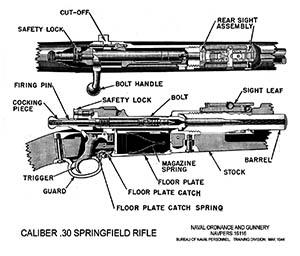
Developers start featured the 1903 Springfield along a two-piece, single-banded wooden body with a straight stock. Internal mechanisms were held at the rear of the torso with the 24" barrel protruding a short distance alee of the fore cease. The commodities handle, situated over the right side of the receiver, had a ball at its end to ensure an easier handgrip. The mag was internal and fixed in identify, requiring the use of cartridge "chargers" (prefabricated strips containing five cartridges). Front end and end atomic number 26 sights were fitted to the weapon, rounding out the weapon's weight to about nine pounds. The 1903, a short rifle successfully filled the dual role of an accurate infantry weapon and a carbine for use past mounted troops.
In 1905, improvements to the Model 1903 Springfield introduced new front and rear sights, and the Model 1905 knife bayonet. The next yr, responding to the introduction of the German "spitzer" (pointed) bullet, the US adopted a 150-grain pointed circular to replace the .30-03 bullet, and the rifle was again redesigned to have the new ammunition. The rifle and cartridge then came to be known as the "xxx-06 Springfield", a configuration that remained basically unchanged for the adjacent xl years.
The Springfield Burglarize in Service
 During World War I, the 1903 Springfield Rifle was widely used by U.S. forces. The burglarize'due south activity was smooth and reliable nether the worst battlefield conditions, and a trained shooter could go off 10 to 15 shots a minute. Accuracy was fantabulous, out to an effective range of 656 to 1,000 yards, with hits possible at 2,500 yards.
Due to its range, the 1903 rifle was likewise used as a sniper rifle. The Army fitted some of their 1903s with a prismatic Warner and Swasey Model 1908 "Musket Sight", while the Marines used a Model 1903 with a Winchester A-5 Telescopic. After the conflict in Europe ended, the government retained the 1903 as the standard outcome for the Ground forces instead of the .30 caliber Model 1917 Rifle (based on a 1914 British Enfield Rifle design) extensively employed by the American Ground forces during the war.
Service Afterwards World War I
In the early 1930s, the U.S. Army adopted a version of the venerable 1903 Springfield in the course of the .30 caliber Model 1903A1 Special Target Burglarize.
When the M1 Garand Semi-Automatic Rifle was adopted past the U.South. Army in 1936, product of the Model 1903 ceased. But at the start of Earth State of war II, the 1903 got an additional lease on life when its replacement, the Garand, became short in supply. The early fighting in the Southward Pacific was carried-out with the definitive Model 1903 Springfield, the Model 1903A3. Many were issued to rear area echelon personnel until early on 1944. These rifles, cheaper to brand than the original 1903, were authorized for the U.S. Armed Forces in May 1942, and were produced by the Remington Artillery Company, and the Smith-Corona Typewriter Company. It was a redesign of the 1903A1 with one principle difference: the addition of an adjustable discontinuity sight mounted at the rear of the receiver. The 1903A3 could also fire grenades using the "MI" launcher.
A sniping version of the 1903A1, the Model 1903A4—the just sniper rifle to see meaning service with the U.S. Army in Globe War Two—was built by Remington. Weighing ix pounds six ounces, it was fitted with a M73B1 Telescopic Sight. During the state of war, the U.S. Marine Corps fought with the best American sniper rifle of the war—its Model 1903A1 using an 8X Unertl Telescope.
Rebuilt Model 1903A4s with "M84"Telescopes, as well equally the Marine'due south Model 1903A1 Unertl sniper rifles, served in the Korean War, and remarkably, some 1903A4s saw combat in the Vietnam State of war.
The final Model 1903 Springfield Rifle left American military service in 1974, after 1,300,00 plus were built, and 71 years later beginning entering the U.S. Army's armory.
Source: https://warfarehistorynetwork.com/2015/03/20/an-american-legend-the-1903-springfield-rifle/
0 Response to "What You Need to Know About Springfield 03"
Post a Comment